

On July 4th, President Trump signed H.R. 1, the One Big Beautiful Bill Act, into law. The 330-page act contains provisions that will reshape nearly every sector of the American economy and society. The rushed passage and sweeping scope of H.R. 1 have left many wondering:
What’s actually in the bill and how will it affect me?
At Plural, this opacity strikes directly against our mission. From our open data to our AI bill summarizer trained specifically on legislative text, we strongly believe in the power of technology to unlock legislative insights for policy professionals, activists, and citizens alike. With this mission in mind, we are producing a series of One Big Beautiful Bill explainers. Within each explainer, we will dive into the megabill’s impact in a specific subject area with a text-first approach that pulls impacts directly from the bill. This week we take a look at how the new law will impact American healthcare.
Our Mission
The Power of Plural
We help you shape policy, so that you can shape the future. It starts with providing the most complete information about policies that impact us.
The teams that for the policies of tomorrow will use the latest technology to empower many voices. Plural exists to make policy creation more transparent, responsive, and inclusive. And to make full participation possible.
The rapid advancement in artificial intelligence technology and its availability has been a defining theme of this decade so far. The speed at which large language models have become a part of our daily lives has seemingly shocked everybody, from industry leaders to policymakers. Lawmakers have just started to respond to these developments with proposals encouraging and regulating the use of AI across industries (we’ve written extensively about these actions here).
While most legislative action has been focused at the state level, the development of H.R. 1 gave President Trump an opportunity to attach AI policy to a large legislative package due to be passed on a party-line vote.
Indeed, the Trump administration responded to this opportunity with a bold proposal to impose a 10-year moratorium on the enforcement of state-level AI regulations. This provision was supported by industry but opposed by a bipartisan group of state executives and lawmakers. In the end, the measure failed to gather the support necessary to remain in the final version of the bill and was left on the sidelines as H.R. 1 became law.
While the removal of the moratorium may have been the most impactful H.R. 1 policy development related to AI, the final bill still has implications for the industry and its users. Below we detail some of those important changes.
Government Funding for Artificial Intelligence
One of the federal government’s primary tools to support specific industries is through appropriations. H.R. 1 authorizes billions in federal funding for artificial intelligence projects including:
- $450 million for AI in naval shipbuilding
- $124 million for AI enhancements to the Test Resource Management Center within the Department of Defense
- $145 million to develop AI-powered aerial and naval attack systems
- $500 million for the advancement and expansion of “the artificial intelligence ecosystem” at the Department of Defense and the “Cyber Command artificial intelligence lines of effort”
- $200 million for the deployment of AI to accelerate financial audits at the Department of Defense
- $115 million for nuclear national security missions tied to artificial intelligence
Supporting Transformational Artificial Intelligence Models
Section 50404 of the new law directs the Secretary of Energy to work with industry leaders to ensure the scientific data of the Department of Energy is suitable for use in artificial intelligence and machine learning models.
The law further directs the Secretary to initiate “seed efforts” for self-improving artificial intelligence models powered by this data. This data and these models are intended to be used to develop microelectronics to accelerate innovation especially in the energy sector.
H.R. 1 appropriates $150 million for these efforts. Taken together, this funding and direction indicates a desire from the Trump administration to lead on AI in the microelectronics and energy sectors.
Conclusion
By the time H.R. 1 arrived on President Trump’s desk, the biggest news in the AI policy world was the exclusion of the moratorium on the enforcement of state-level regulations. That provision’s failure opens the door for recently-passed state policy to be implemented and new policy to be developed when 2026 state legislative sessions begin.
Navigating the AI regulatory patchwork in the absence of a national framework will therefore remain an essential task for legal and compliance teams across various industries.
Although the most important takeaway from H.R. 1 as it relates to AI may be what was not included in the bill, a number of important changes in the package will change how AI is developed and utilized in the coming years. Through the appropriations and provisions included in H.R. 1, the Trump administration and Congressional Republicans have shaped the near-future of federal involvement in AI development. Given the global context surrounding the rapid advancement of AI, the decisions made in H.R. 1 will have massive implications for decades to come.
Need help building your team’s AI policy strategy?
Reach out to us to schedule a consultation, get a downloadable copy of our AI policy guide, or see how we help clients lead with confidence in the age of artificial intelligence.
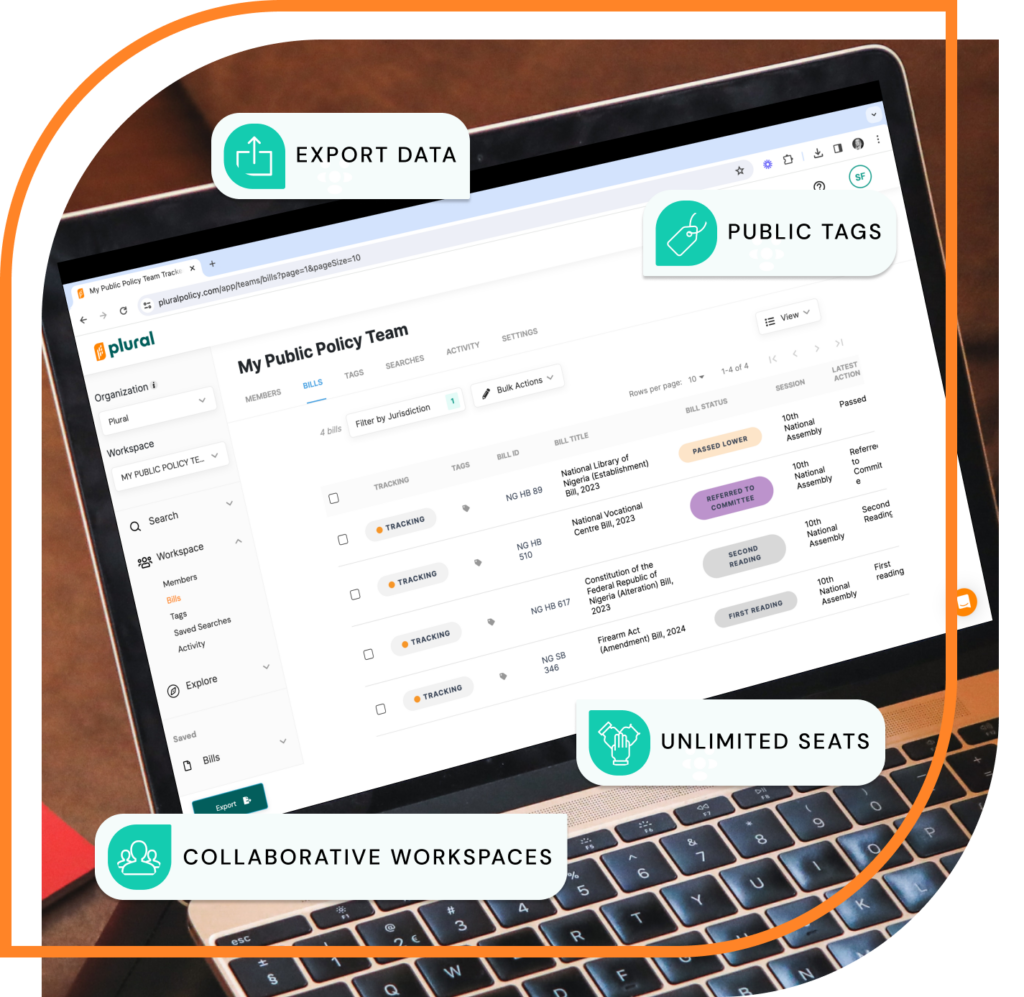
Plural’s AI-powered legislation tracker offers not just data, but foresight, providing real-time updates, predictive analytics, and strategic insights. No matter your needs, we have a plan for you.